Medium-voltage systems
Metal-clad switchgear, vacuum breakers and the protection that governs them
5 kV through 38 kV class distribution: metal-clad and metal-enclosed switchgear, drawout vacuum circuit breakers, protective relaying, metering, control integration, remote operation and racking, arc-resistant applications, condition monitoring and modernization.
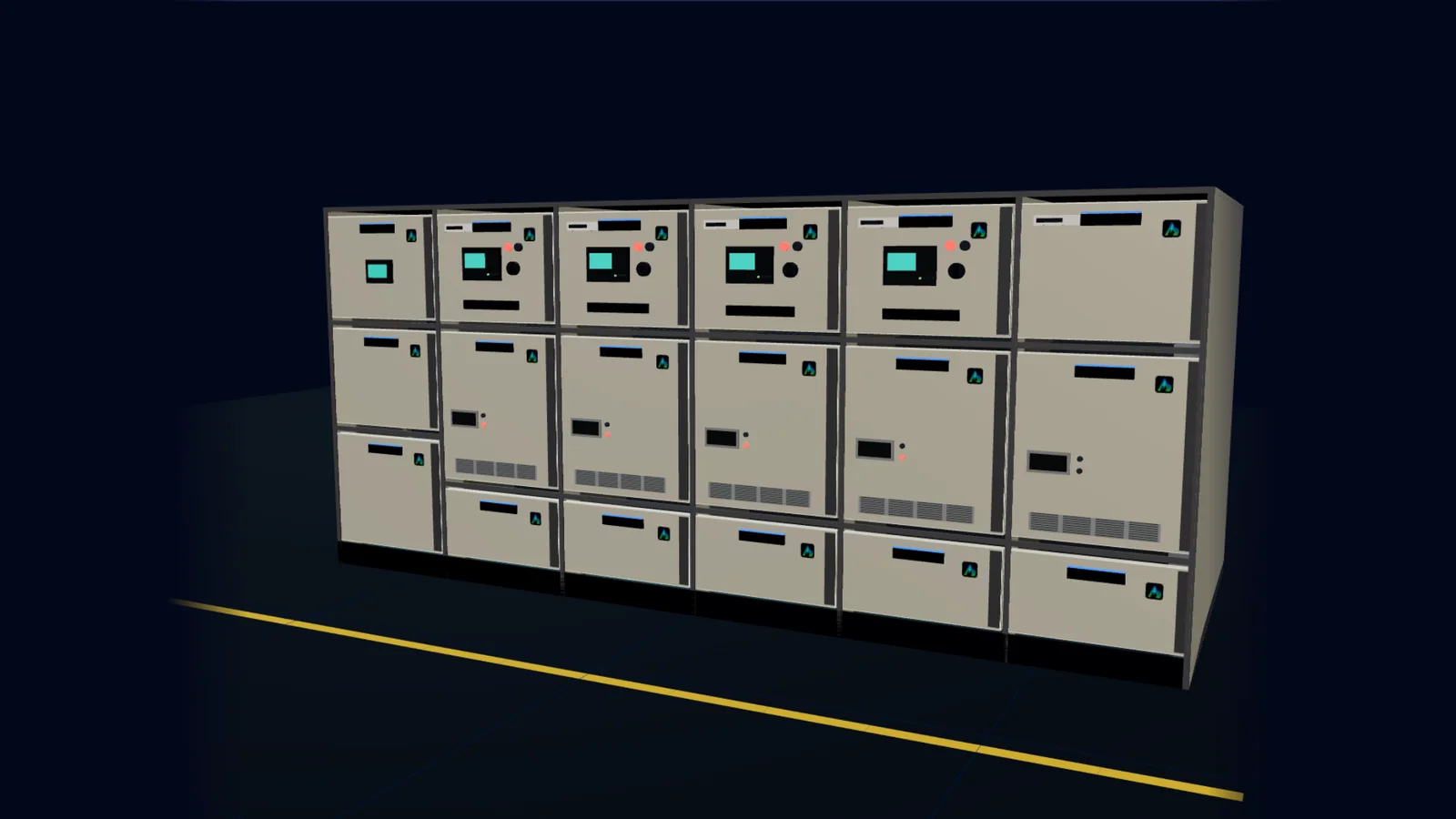
What we engineer and integrate
Medium-voltage scope
Ratings, construction class and protection are chosen against the utility interconnection, the fault study and how the facility intends to operate and maintain the gear.
Metal-Clad Switchgear
5 kV–38 kV class drawout vacuum breaker switchgear with grounded metal barriers between breaker, bus and cable compartments.
Details +Details −
- · Ratings: 4.76–38 kV, 1200–4000 A continuous, 25–63 kA interrupting classes
- · Automatic shutters, racking interlocks, insulated main bus with boots at joints
- · Indoor, outdoor walk-in and non-walk-in, and arc-resistant constructions
- · Relay, metering and control compartments isolated from primary compartments
- · Factory-installed temperature, partial-discharge and mechanism sensors available
Typical applications: Utility service entrances, campus distribution, industrial plants, data center MV distribution
Metal-Clad vs. Metal-Enclosed MV SwitchgearIEEE C37 Switchgear Standards: A Working MapMedium-Voltage Vacuum Circuit Breakers Explained
Metal-Enclosed Switchgear
Load-interrupter switch and fuse or fixed-breaker switchgear where drawout construction is not required.
Details +Details −
- · Air or vacuum load-interrupter switches with current-limiting or expulsion fuses
- · Fixed-mount vacuum breakers for feeder duty
- · Lower cost and footprint than metal-clad; fewer compartment barriers
Typical applications: Transformer primary protection, small MV distribution, unit substations
Vacuum Circuit Breakers
Drawout VCBs for new lineups and replacement breakers for existing cells, with the timing, contact-wear and mechanism data that predictive maintenance needs.
Details +Details −
- · 1200/2000/3000 A frames, stored-energy spring mechanisms, 48–250 Vdc or 120 Vac control
- · Replacement and retrofit breakers engineered to existing cell interfaces
- · Timing, travel, insulation resistance and vacuum integrity testing before shipment
Medium-Voltage Vacuum Circuit Breakers ExplainedPredictive Maintenance for Switchgear and Breakers
Protective Relaying
Multifunction relays applied and set to coordinate with the utility, the transformers and the LV system.
Details +Details −
- · 50/51, 50N/51N, 27/59, 81, 87, 46, 49, 67 and 86 functions as the study requires
- · Settings coordination with the protection engineer of record
- · Maintenance-mode setting groups for arc-flash reduction
- · Relay testing and commissioning documentation
Protective Relaying Fundamentals for SwitchgearArc-Resistant Switchgear: Types, Testing and Limits
Metering
Utility revenue metering sections and owner metering with VT/CT provisions built into the lineup.
Details +Details −
- · Utility-specified metering compartments and sealing provisions
- · Owner power meters with waveform capture on mains and feeders
- · Bus VT drawers with fuse isolation
Control Integration
Local/remote control, interlocking, MTM at medium voltage, and SCADA integration over IEC 61850 or DNP3.
Details +Details −
- · Control schemes documented in schematics and a control narrative
- · Station bus architecture with time synchronization
- · Factory and site acceptance testing of interlocks and remote commands
SCADA for Power Distribution SystemsCybersecurity for Digital Switchgear and Power SCADA
Remote Operation Concepts
Open and close breakers from outside the arc-flash boundary — from an HMI, a pendant or SCADA — with the permissives enforced by the relay and controller.
Details +Details −
- · Local/Remote selection at the door with SCADA command supervision
- · Remote open/close through the relay or a dedicated controller
- · Event logging of every command with source and time stamp
Remote Racking and Remote Breaker OperationNFPA 70E, Maintenance and Switchgear Design Choices
Remote Racking Concepts
Motorized racking operated from a distance so no one stands in front of the cell while the breaker moves between CONNECTED, TEST and DISCONNECTED.
Details +Details −
- · Portable or integrated motorized racking devices
- · Interlocks confirm breaker open before racking begins
- · Procedures aligned with the facility's electrical safety program
Arc-Resistant Applications
Arc-resistant metal-clad construction tested to IEEE C37.20.7 accessibility types, with the plenum, room and procedural requirements that make it effective.
Details +Details −
- · Type 1, Type 2, 2B and 2C accessibility designations
- · Pressure-relief plenums or ducts and room design coordination
- · Protection only applies with doors closed and latched — procedures matter as much as construction
Arc-Resistant Switchgear: Types, Testing and LimitsNFPA 70E, Maintenance and Switchgear Design Choices
Condition Monitoring
Temperature at stabs, joints and terminations; partial discharge on MV insulation; mechanism timing and operation counts — trended, not just alarmed.
Details +Details −
- · Wireless or fiber-optic temperature sensors where infrared cannot see
- · TEV / UHF partial-discharge sensing in cable compartments
- · Breaker mechanism monitoring: coil current signatures, charging time, operation counts
- · Data to the historian and analytics layer over Modbus or IEC 61850
Switchgear Condition Monitoring: What to Measure and WhyWhat Is Digital Switchgear?
Modernization
Relay upgrades, breaker replacement, monitoring retrofits and control additions for lineups that are structurally sound but electronically obsolete.
Details +Details −
- · Assessment of structure, bus, insulation and breaker condition
- · Electromechanical-to-digital relay conversions with wiring and CT/VT review
- · Replacement breakers for obsolete cells
- · Phased outages planned with operations
What Is Digital Switchgear?Predictive Maintenance for Switchgear and Breakers
Interactive MV switchgear
Six sections, ten ways to look at them
Exterior, doors open, breaker, main bus, cable compartment, protection, controls, sensors, digital twin and maintenance. Every compartment explains itself when selected.
Construction class described by IEEE C37.20.2
Doors closed — as an operator sees it.
Inspector
Select a compartment on the 3D model or a device on the one-line. The model, the one-line and the data panel stay in sync: physical equipment ↔ digital twin ↔ data.
- · Click MV Main 52-M1 on the one-line to highlight its breaker compartment.
- · Click the bus to cut the enclosure away to the main bus compartment.
- · Choose the Sensors mode to see where each sensor physically sits.
Brand-neutral demonstration architecture. Compartment arrangement, ratings and sensor placements are representative of common ANSI practice, not a specific manufacturer's design or a specific Apex project. Values are simulated.
| Metal-clad | Metal-enclosed (interrupter) | |
|---|---|---|
| Standard | IEEE C37.20.2 | IEEE C37.20.3 |
| Switching device | Drawout vacuum circuit breakers | Load-interrupter switches with fuses, or fixed breakers |
| Compartments | Grounded metal barriers between breaker, bus and cable compartments; automatic shutters | Fewer barriers; devices may share a compartment |
| Bus | Insulated, with boots at joints | Bare or insulated depending on design |
| Interlocks | Racking interlocks, shutters, LV control isolation | Switch/fuse door interlocks |
| Maintenance | Rack out a breaker with the bus energized | Typically requires an outage of the section |
| Where it fits | Main distribution, frequent switching, high fault duty, critical loads | Transformer primaries, small MV distribution, cost-sensitive feeders |
Designing for the person in front of the gear
Arc-flash exposure is a design input
Remote racking
Motorized racking operated from outside the arc-flash boundary. The single most effective way to take people away from the highest-energy task in MV switchgear.
Remote operation
Open and close from the HMI, SCADA or a pendant. Local/Remote selection and command logging keep control of who can do what.
Maintenance-mode settings
A relay setting group with reduced instantaneous pickup, selectable at the door and visible in SCADA, lowers incident energy while work is in progress.
Arc-resistant construction
Tested to IEEE C37.20.7 accessibility types. Effective only with doors closed and latched, which is why it pairs with remote racking rather than replacing it.
Continuous monitoring
Temperature and partial-discharge sensors reduce the need to open doors for inspection, and catch degradation between outages.
IR windows and viewing ports
Where periodic thermography is still part of the program, windows keep covers on while it happens.
Apex Power Distribution · ApexPower.ai
Let's engineer the power system —
and the intelligence around it.
Send a one-line, a specification or a photo of what is installed today. An engineer reviews it and tells you what fits — equipment, protection, controls and monitoring — before anyone talks price.