Apex Power DistributionApexPower.ai

Apex Power Distribution · ApexPower.ai

Engineered Power.
Intelligent Control.

LV + MV Switchgear | Automation | Digital Monitoring | Machine Intelligence

Low- and medium-voltage switchgear, automation, digital monitoring and machine intelligence engineered as one integrated power system.

Equipment
Switchboards, LV power switchgear, MV metal-clad, ATS, main-tie-main
Controls
Protection, PLC/RTU, SCADA, IEC 61850, DNP3, Modbus
Intelligence
Condition monitoring, asset health, predictive maintenance
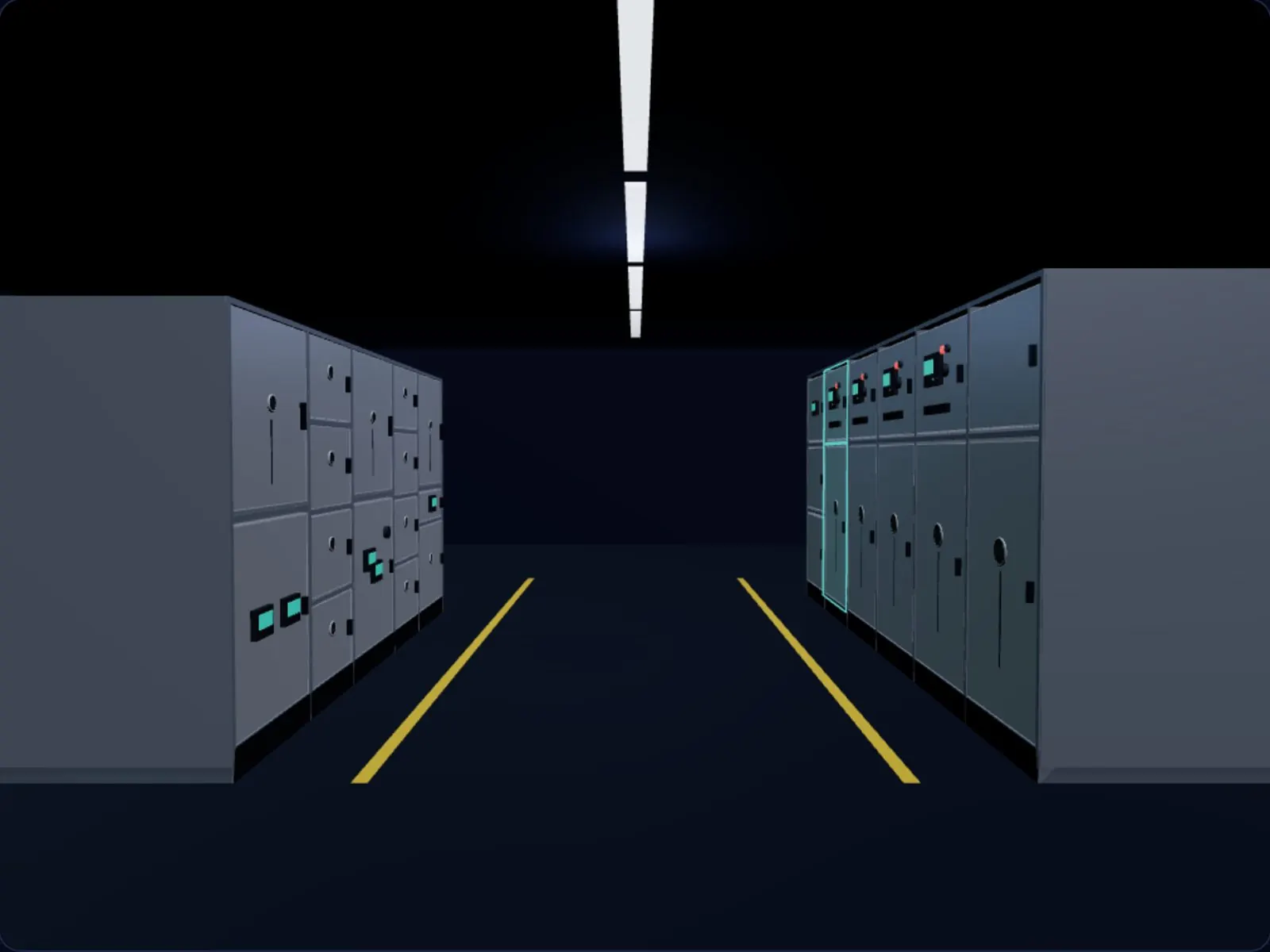
Rendering of an electrical room with low-voltage power switchgear on the left, medium-voltage metal-clad switchgear on the right and an open center aisle

Interactive one-line: utility to MV main, MV bus, feeder, transformer, LV main, LV bus, tie and critical feeders

MV Bus — 13.8 kV, 1200 AMV BUS · 13.8 kV · 1200 ALV Bus 1 — 480Y/277 V, 4000 ALV BUS 1 · 480Y/277 V · 4000 A Utility Source — Utility service entrance to the customer-owned medium-voltage switchgear.UTILITY SOURCE · 13.8 kV52-M1 MV Main — Interrupts load and fault current for the entire medium-voltage bus under control of the main protective relay.52-M1■ CLOSED412 / 409 / 415 A52-F1 MV Feeder 1 → T1 — Feeds transformer T1. Relay settings coordinate with the transformer damage curve and the LV main.52-F1■ CLOSED60 AT1 Transformer T1 — Unit-substation transformer feeding LV Bus 1 through the 52-LM1 main.T1 · 2000 kVA13.8 kV Δ – 480Y/277 V · Z 5.75 %52-LM1 LV Main 1 — Main breaker for LV Bus 1. Participates in the main-tie-main automatic transfer scheme.52-LM1■ CLOSED1,732 A52-T Tie — Tie breaker between LV Bus 1 and LV Bus 2. Closed automatically by the MTM controller after a main opens on loss of source (open transition).52-T□ OPEN0 A52-C1 UPS A Input — Feeds the UPS A input (critical load path).52-C1■ CLOSED640 A52-C2 Mechanical A — Feeds the mechanical MCC A (chillers, pumps, fans).52-C2■ CLOSED830 A52-C3 Process & Lighting A — Feeds process and lighting distribution panels.52-C3■ CLOSED262 A UPS A → Critical Load — Critical IT / process load via UPS A.UPS A → Critical Load Mechanical MCC A — Mechanical loads.Mechanical MCC A Process / Lighting — Distribution panels.Process / Lighting

Physical power meets digital intelligence

The power system comes first. The intelligence is built around it.

Apex Power Distribution engineers, integrates and modernizes low- and medium-voltage distribution equipment — then adds the protection, automation, communications and analytics that let the people responsible for it see what it is doing and act before something fails.

01

Physical power equipment

LV switchboards and power switchgear, MV metal-clad and metal-enclosed switchgear, automatic transfer switches, main-tie-main and paralleling — engineered, integrated and modernized with ratings and coordination that stand up to the study.

LV and MV systems
02

Protection, automation and controls

Relays, trip units, PLC/RTU logic, transfer schemes and SCADA integration over Modbus, DNP3 and IEC 61850 — documented in a control narrative and proven in factory and site acceptance tests.

Automation & controls
03

Data and machine intelligence

Combine breaker, relay, meter and sensor data to identify abnormal equipment behavior before it becomes an outage. Health scores and anomaly detection support maintenance decisions; protection keeps protecting.

AI & analytics

Interactive MV switchgear

Metal-clad switchgear you can open, rack and inspect

A six-section 15 kV class lineup with drawout vacuum circuit breakers, insulated main bus and rear cable compartments. Select any compartment to see what it does, how it is rated and what data it produces.

MV systems
Demonstration model — simulated states

Construction class described by IEEE C37.20.2

Doors closed — as an operator sees it.

Loading 3D switchgear model…

Inspector

Select a compartment on the 3D model or a device on the one-line. The model, the one-line and the data panel stay in sync: physical equipment ↔ digital twin ↔ data.

  • · Click MV Main 52-M1 on the one-line to highlight its breaker compartment.
  • · Click the bus to cut the enclosure away to the main bus compartment.
  • · Choose the Sensors mode to see where each sensor physically sits.

Brand-neutral demonstration architecture. Compartment arrangement, ratings and sensor placements are representative of common ANSI practice, not a specific manufacturer's design or a specific Apex project. Values are simulated.

Interactive LV equipment

Switchboard or low-voltage power switchgear — see the difference

A UL 891 switchboard with group-mounted molded-case breakers next to UL 1558 drawout power switchgear in a main-tie-main arrangement. Same voltage, very different maintainability, footprint and cost.

LV systems
Demonstration model — simulated states

Construction class described by UL 1558 / IEEE C37.20.1; breakers per UL 1066 / IEEE C37.13

Doors closed — as an operator sees it.

Loading 3D switchgear model…

Inspector

Select a compartment on the 3D model or a device on the one-line. The model, the one-line and the data panel stay in sync: physical equipment ↔ digital twin ↔ data.

  • · Click MV Main 52-M1 on the one-line to highlight its breaker compartment.
  • · Click the bus to cut the enclosure away to the main bus compartment.
  • · Choose the Sensors mode to see where each sensor physically sits.

Brand-neutral demonstration architecture. Compartment arrangement, ratings and sensor placements are representative of common ANSI practice, not a specific manufacturer's design or a specific Apex project. Values are simulated.

Intelligent Mimic

One-line, physical equipment and data — in sync

Utility → 15 kV main → MV bus → feeder → transformer → 480 V main → LV bus ↔ tie → critical feeders. Switch layers, run a scenario, and watch the 3D model follow your selection.

Full-screen mimic
Demonstration — simulated values

Topology, breaker positions and energized paths.

Both transformers energized from the MV bus; LV Bus 1 and Bus 2 each carried by their own main. Tie open. Generator in standby.

One-line diagram — Normal — utility, mains closed, tie open

MV Bus — 13.8 kV, 1200 AMV BUS · 13.8 kV · 1200 ALV Bus 1 — 480Y/277 V, 4000 ALV BUS 1 · 480Y/277 V · 4000 ALV Bus 2 — 480Y/277 V, 4000 ALV BUS 2 · 480Y/277 V · 4000 A Utility Source — Utility service entrance to the customer-owned medium-voltage switchgear.UTILITY SOURCE · 13.8 kV52-M1 MV Main — Interrupts load and fault current for the entire medium-voltage bus under control of the main protective relay.52-M1 MV Main■ CLOSED52-F1 MV Feeder 1 → T1 — Feeds transformer T1. Relay settings coordinate with the transformer damage curve and the LV main.52-F1 MV Feeder 1 → T1■ CLOSED52-F3 MV Feeder 3 — Feeds other medium-voltage loads (e.g., a remote unit substation). Shown in the MAINTENANCE state in one demo scenario.52-F3 MV Feeder 3■ CLOSED52-F2 MV Feeder 2 → T2 — Feeds transformer T2 (second source of the double-ended LV switchgear).52-F2 MV Feeder 2 → T2■ CLOSEDT1 Transformer T1 — Unit-substation transformer feeding LV Bus 1 through the 52-LM1 main.T1 · 2000 kVA13.8 kV Δ – 480Y/277 V · Z 5.75 %T2 Transformer T2 — Unit-substation transformer feeding LV Bus 2 through the 52-LM2 main.T2 · 2000 kVA13.8 kV Δ – 480Y/277 V · Z 5.75 %52-LM1 LV Main 1 — Main breaker for LV Bus 1. Participates in the main-tie-main automatic transfer scheme.52-LM1 LV Main 1■ CLOSED52-T Tie — Tie breaker between LV Bus 1 and LV Bus 2. Closed automatically by the MTM controller after a main opens on loss of source (open transition).52-T Tie□ OPEN52-LM2 LV Main 2 — Main breaker for LV Bus 2.52-LM2 LV Main 2■ CLOSED52-G Generator Breaker — Connects the standby generator to LV Bus 2 after both utility sources are lost and the mains are open (open transition).52-G Generator Breaker□ OPENG1 Standby Generator G1 — Standby generator (system demo). Emergency system classification and transfer times depend on the facility's code requirements.GG1 · 1500 kW52-C1 UPS A Input — Feeds the UPS A input (critical load path).52-C1 UPS A Input■ CLOSED52-C2 Mechanical A — Feeds the mechanical MCC A (chillers, pumps, fans).52-C2 Mechanical A■ CLOSED52-C3 Process & Lighting A — Feeds process and lighting distribution panels.52-C3 Process & Lighting A■ CLOSED52-C4 UPS B Input — Feeds the UPS B input.52-C4 UPS B Input■ CLOSED52-C5 Mechanical B — Feeds the mechanical MCC B. Communication loss on this trip unit is one demo scenario.52-C5 Mechanical B■ CLOSED52-C6 Spare / Future — Spare feeder for future load.52-C6 Spare / Future□ OPEN UPS A → Critical Load — Critical IT / process load via UPS A.UPS A → Critical Load Mechanical MCC A — Mechanical loads.Mechanical MCC A Process / Lighting — Distribution panels.Process / Lighting UPS B → Critical Load — Critical load via UPS B.UPS B → Critical Load Mechanical MCC B — Mechanical loads.Mechanical MCC B Other MV Loads — Remote unit substation / MV motors (demo).Other MV LoadsDemonstration — simulated values, not a live control interface
  • CLOSED
  • OPEN
  • TRIPPED
  • MAINTENANCE
  • COMMUNICATION LOST
  • Energized
  • De-energized
  • 52-M1 MV Main: CLOSED
  • 52-F1 MV Feeder 1 → T1: CLOSED
  • 52-F3 MV Feeder 3: CLOSED
  • 52-F2 MV Feeder 2 → T2: CLOSED
  • 52-LM1 LV Main 1: CLOSED
  • 52-T Tie: OPEN
  • 52-LM2 LV Main 2: CLOSED
  • 52-G Generator Breaker: OPEN
  • 52-C1 UPS A Input: CLOSED
  • 52-C2 Mechanical A: CLOSED
  • 52-C3 Process & Lighting A: CLOSED
  • 52-C4 UPS B Input: CLOSED
  • 52-C5 Mechanical B: CLOSED
  • 52-C6 Spare / Future: OPEN

Device panel

Select a breaker, bus, transformer or source on the one-line. Switch layers to see how the same device appears in protection, controls, communications, sensors, data and analytics.

Automation & controls

Six layers, one architecture

Power, protection, control, communications, data and intelligence — each layer does one job, and each depends only on the layers below it. Protection never waits for the network; analytics never operate a breaker.

Power layer

The equipment that carries and switches current. Everything above exists to protect, operate and understand this layer.

Elements

  • · Switchgear (LV and MV)
  • · Switchboards
  • · Circuit breakers
  • · Transformers
  • · Automatic transfer switches
  • · Generators
  • · BESS / inverter sources
  • · Loads

Apex scope

Engineering, integration and modernization of the LV and MV distribution equipment; ratings, coordination and arrangement.

Machine intelligence for power systems

Asset health you can defend in a maintenance meeting

Predictive maintenance, thermal anomaly detection, power-quality intelligence and asset health scoring — built from inspection data, operating history, sensors, alarms and maintenance records.

Asset health — 52-LM1 LV Main 1

87/ 100
Healthy

Healthy — Monitor breaker operating time trend

The score combines weighted evidence from six sources. It is a prioritization aid for the maintenance planner — it does not change protection settings or operate equipment.

Contributing factors (illustrative)

  • Inspection dataLast NETA-style inspection 14 months ago; no findings18/20
  • Operating history2,118 operations; 3 fault interruptions lifetime17/20
  • Sensor dataStab temperature ΔT normal; opening time 38 ms (baseline 32 ms)20/25
  • Alarms0 alarms / 30 days; 1 advisory (timing trend)9/10
  • MaintenanceLubrication overdue by 4 months per time-based plan12/15
  • Equipment age9 years in service (design life 30+)11/10

Weights and scoring are configured per asset class and site. Confidence is reported alongside the score when the data record is thin.

Machine-learning analytics support engineering and maintenance decisions. Protective functions and switching operations remain governed by approved protection, control and safety procedures.

Multi-platform power expertise

Engineering and integration experience across ABB, Eaton and Schneider Electric power platforms

Multi-platform expertise for leading LV and MV switchgear ecosystems — and the monitoring layer that ties them together.

Schneider Electric / Square D

Platform experience — engineering and integration

LV switchboards and LV power switchgear, MV metal-clad and metal-enclosed switchgear, trip units and protective relays, power meters

Eaton

Platform experience — engineering and integration

LV switchboards and LV power switchgear, MV metal-clad switchgear and vacuum breakers, trip units and relays, power monitoring

ABB

Platform experience — engineering and integration

MV metal-clad switchgear and vacuum breakers, protective relays and IEDs, LV power breakers and switchgear, condition monitoring

Capabilities across platforms

  • · Equipment integration
  • · Modernization and retrofit
  • · Breaker applications and replacement planning
  • · Metering and power quality
  • · Protection settings coordination
  • · Controls and transfer logic
  • · Communications and SCADA integration
  • · Field support, testing and commissioning

Most facilities run more than one manufacturer's equipment. Engineering and integration experience across ABB, Eaton and Schneider Electric power platforms lets us specify, coordinate and modernize what is already installed, connect it to a common monitoring layer, and plan replacements on the customer's schedule rather than a single vendor's catalog.

ABB, Eaton, Schneider Electric and Square D are trademarks of their respective owners. Apex Power Distribution is an independent engineering and integration company. References to these platforms describe engineering experience only and do not imply that Apex is an authorized distributor, manufacturer's representative, certified partner or factory of any manufacturer unless stated in a specific proposal.

Engineering resources

Written for the people who write the specs

All resources
  • Equipment

    Switchboard vs. Switchgear: What Actually Differs

    Switchboards and low-voltage power switchgear both distribute power at 600 V and below, but they are built to different standards and behave differently under fault, during maintenance and across a service life. This article lays out the concrete differences and the conditions under which each is the right specification.

    7 min read · Updated 2026-09

  • Equipment

    Metal-Clad vs. Metal-Enclosed MV Switchgear

    Metal-clad and metal-enclosed are not synonyms: metal-clad is a specific class of medium-voltage switchgear with construction requirements that metal-enclosed interrupter switchgear does not have to meet. Understanding the difference keeps specifications honest and prevents paying for, or missing, features the application needs.

    7 min read · Updated 2026-09

  • Protection & Controls

    Main-Tie-Main Systems: Design and Automatic Transfer Logic

    A main-tie-main lineup splits the bus so that two sources each carry part of the load and either can pick up the whole load when the other is lost. The value is in the automatic transfer logic, and this article explains how source loss is detected, how the transfer is sequenced, and which interlocks keep the scheme from doing harm.

    8 min read · Updated 2026-09

  • Digital & Monitoring

    Predictive Maintenance for Switchgear and Breakers

    Predictive maintenance uses operating data and trends to schedule breaker and switchgear work when the equipment needs it, rather than on a fixed calendar. This article explains how it differs from time-based and condition-based programs, which failure modes it can realistically anticipate, and where human judgment stays in the loop.

    7 min read · Updated 2026-09

  • Digital & Monitoring

    What Is Digital Switchgear?

    Digital switchgear is conventional low- or medium-voltage switchgear in which sensors, intelligent electronic devices (IEDs) and communications are designed in as part of the assembly rather than added as accessories. This article defines the term, explains what changes inside the lineup, and weighs the benefits against the practical caveats of adopting it.

    7 min read · Updated 2026-09

  • Digital & Monitoring

    Cybersecurity for Digital Switchgear and Power SCADA

    Once relays, meters and controllers are networked, the switchgear lineup is part of the facility's attack surface. This article covers the concepts that matter for protecting power distribution systems, from network segmentation and access control to device hardening, logging and the standards that define what secure IEDs and secure architectures look like.

    8 min read · Updated 2026-09

Upload your one-line

Start with the drawing, not the sales call

Send us the one-line, specification or equipment schedule. Our engineering team will review the system requirements, equipment configuration, controls and schedule considerations.

  • · One-line diagram, equipment schedule, specifications, BOM
  • · Photos and nameplate data of existing equipment
  • · Voltage, ampacity, available fault current, required-on-site date
  • · Automation, monitoring and communication requirements

Send us the one-line, specification or equipment schedule. Our engineering team will review the system requirements, equipment configuration, controls and schedule considerations. Fields marked * are required.

Project
System

System or service voltage

Main bus / main device, e.g., 4000 A

If known, e.g., 42 kA

No relationship implied — used to match existing equipment or specs

Automation requirements

Select everything that applies.

Files

One-line diagram, equipment schedule, specifications, BOM, photos, existing equipment information. Up to 10 files, 25 MB each (.pdf, .dwg, .dxf, .xlsx, .xls, .csv, .docx, .doc, .png, .jpg, .jpeg, .zip). Files are sent as email attachments: after you press Send, your email client opens with the details and you attach the files you selected here.

Scope, constraints, existing equipment, site conditions, standards or specifications to follow

Opens a pre-filled email to support@apexpowertx.com in your mail client. We review submissions during business hours and reply by email. No instant quote is generated from this form.

Apex Power Distribution · ApexPower.ai

Let's engineer the power system — and the intelligence around it.

Send a one-line, a specification or a photo of what is installed today. An engineer reviews it and tells you what fits — equipment, protection, controls and monitoring — before anyone talks price.